DMD - Products
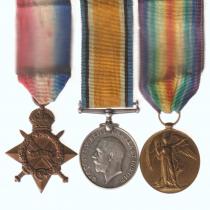
J.14319 JOHN WALTER BEER, AB. ROYAL NAVY, KILLED IN ACTION SERVING IN HMS.'MONMOUTH' AT CORONEL
1914-15 Star; British War Medal; Victory Medal 1914-19 (J.14319 J.W. BEER, AB. RN.): (JOHN WALTER BEER - Born 22 January 1894 at Dawlish, Devon, a labourer by trade when on 21 October 1911 he joined the Royal Navy as a Boy Class 2 at HMS. 'Ganges 11'. He moved to HMS. 'Africa' from 8 February 1912 and two days later was advanced to Boy Class 1 in that ship. He was advanced to Ordinary Seaman from 21 April 1912 moved to HMS.'Implacable' on 14 May 1912 and to HMS. 'Roxburgh' from 19 June 1912 and then to HMS. 'Blake' from 13 August 1912. He was advanced to AB. from 22 April 1913 and moved to HMS. 'Vivid 1' on 2 May 1914. He joined the crew of the Monmouth-Class armoured cruiser, HMS. 'Monmouth' from 30 July 1914, the ship being mobilised from 4 August 1914, upon the outbreak of the First World War. Upon mobilisation 'Monmouth' was sent to the Central Atlantic to join the 5th. Cruiser Squadron of Rear Admiral Archibald Stoddart, to search for German commerce raiders, arriving there on 13 August 1914, whereupon it was detached to patrol the Brazilian coast for German ships and was later ordered to the South Atlanttic to join the squadron of Rear Admiral Christopher Cradock in the search for tthe German East Asia Squadron. On 27 October 1914 'Monmouth' with the rest of the Squadron was at Vallenar Roads in the remote Chonos Archipelago of Chile in order to recoal. Admiral Cradock sent the light cruiser 'Glasgow' to scout ahead and enter Coronel to collect any Admiralty messages, but a German supply ship was already there and reported the presence of 'Glasgow' to the German Commander, Admiral Spee. 'Glasgow' departed Coronel at 0915 on 1 November 1914 and rendezvoused with the rest of the Squadron four hours later. The British ships were steaming line abreast and their funnel smoke was seen by the Germans. Spee immediately signalled his ships to close on the British ships and to open fire when the range was reduced to 12,300 yards. The German Armoured Cruisers 'Scharnhorst' and 'Gneisenau' proved to be much faster and more heavily armed than the British ships and the German gunner's shooting was very accurate, quickly scoring hits on the British ships while still outside the range of the British six-inch guns. One shell from 'Gneisenau' blew the roof off Monmouth's forward turret starting a fire, causing an ammunition explosion which completely blew the turret off the ship. Severely damaged, 'Monmouth' began to slow and veered out of line, listing to port. The German cruiser ' Nurnberg' came upon 'Monmouth' which still had its 'colours flying' and after receiving no response to a searchlight challenge and upon the British ship increasing speed and turning towards it, opened fire. 'Monmouth' capsized with the loss of the entire crew of 734 men. The recipient was the son of Walter and Maria Beer of 'Tuckers Cottage' Ide, Exeter, Devon, he has no known grave and is commemorated on the Plymouth Naval Memorial and the Ide Village War Memorial, he was just 20 years of age at the date of his death.). Sold with verification, copy Service Record, copy CWGC. Record information, copy Census records and other related research. Medals mounted on long lengths of faded original silk ribbon EF - £495